FarnaFarain

- TheTinkerBells
- bangi, selangor, Malaysia
- We are from Tesl B We was named by Farnafarain Saidatulain Ahmad Farhan Ahmad Farouq Hatim Nabihah We all hope, the visitor can grab something from here AND don't just view and forgot to have some reading... We hope this segment can improve your English language then will increase your comprehension on grammar. That's all from us.. GET SOMETHING FROM NOTHING

Showing posts with label FAROUQ. Show all posts
Showing posts with label FAROUQ. Show all posts
02 January 2011


Demonstratives
In this lesson, we will discuss demonstratives of two types: demonstrative adjectives and demonstrative pronouns. The first step in clearly understanding these two topics is to review the differences between "adjectives" and "pronouns."
adjective
describes a nounpronoun
takes the place of a noun
In the following sentences, the words in bold all function as adjectives, since they all describe the noun "book."
Give me the red book.
Give me the big book.
Give me that book.
Give me this book.
Notice that adjectives answer the question "Which?" in relation to the nouns that they modify. (Which book? The red book. The big book. That book. This book.)
In the following sentences, the words in bold all function as pronouns, since they all take the place of a noun.
Maria is next; give her the ball.
Juan is here; say hello to him.
That pencil is yours; this is mine.
This book is mine; that is yours.
Notice that pronouns replace a noun. ("her" replaces "Maria" - "him" replaces "Juan" - "this" replaces "pencil" - "that" replaces "book")
As you have just seen, the words "this" and "that" can function as both adjectives and pronouns.
This book is mine. (adjective)
This (one) is mine. (pronoun)That book is yours.(adjective)
That (one) is yours. (pronoun)
The demonstrative adjectives also have four forms:
(this book)
(these books)
(this pen)
(these pens)(that book)
(those books)
(that pen)
(those pens)(that book over there)
(those books over there)
(that pen over there)
(those pens over there)
Here are the corresponding demonstrative pronouns:
(this one - masculine)
(these ones - masculine)
(this one - feminine)
(these ones - feminine
(that one - masculine)(those ones - masculine)
(that one - feminine)
(those ones - feminine)(that one over there - masc.)
(those ones over there - masc.)
(that one over there - fem.)
(those ones over there - fem.)
Each demonstrative pronoun also has a neuter form. They do not change for number or gender, and they are used to refer to abstract ideas, or to an unknown object.
(this matter, this thing)
(that matter, that thing)
(that matter/thing over there)
01 January 2011
TONGUE TWISTER
YOU ALL SHOULD WATCH THIS
1) Peter Piper picked a peck of pickled peppers.
A peck of pickled peppers Peter Piper picked.
If Peter Piper picked a peck of pickled peppers,
Where's the peck of pickled peppers Peter Piper picked?
A peck of pickled peppers Peter Piper picked.
If Peter Piper picked a peck of pickled peppers,
Where's the peck of pickled peppers Peter Piper picked?
2) I saw Susie sitting in a shoe shine shop.
Where she sits she shines, and where she shines she sits.
Where she sits she shines, and where she shines she sits.
3) Denise sees the fleece,
Denise sees the fleas.
At least Denise could sneeze
and feed and freeze the fleas.
Denise sees the fleas.
At least Denise could sneeze
and feed and freeze the fleas.
4) Something in a thirty-acre thermal thicket of thorns and thistles thumped and thundered threatening the three-D thoughts of Matthew the thug - although, theatrically, it was only the thirteen-thousand thistles and thorns through the underneath of his thigh that the thirty year old thug thought of that morning.
5)I wish to wish the wish you wish to wish, but if you wish the wish the witch wishes, I won't wish the wish you wish to wish.
6) Luke Luck likes lakes.
Luke's duck likes lakes.
Luke Luck licks lakes.
Luck's duck licks lakes.
Duck takes licks in lakes Luke Luck likes.
Luke Luck takes licks in lakes duck likes.
Luke's duck likes lakes.
Luke Luck licks lakes.
Luck's duck licks lakes.
Duck takes licks in lakes Luke Luck likes.
Luke Luck takes licks in lakes duck likes.
7) One-one was a race horse.
Two-two was one too.
One-one won one race.
Two-two won one too.
Two-two was one too.
One-one won one race.
Two-two won one too.
8) If Pickford's packers packed a packet of crisps would the packet of crisps that Pickford's packers packed survive for two and a half years?
9) What a terrible tongue twister,
what a terrible tongue twister,
what a terrible tongue twister...
what a terrible tongue twister,
what a terrible tongue twister...
10) How much ground would a groundhog hog, if a groundhog could hog ground? A groundhog would hog all the ground he could hog, if a groundhog could hog ground.
Five Grammatical Errors that Make You Look Dumb
One thing blogging and good copywriting share is a conversational style, and that means it’s fine to fracture the occasional rule of proper grammar in order to communicate effectively. Both bloggers and copywriters routinely end sentences with prepositions, dangle a modifier in a purely technical sense, or make liberal use of the ellipsis when an EM dash is the correct choice—all in order to write in the way people actually speak.
But there are other mistakes that can detract from your credibility. While we all hope what we have to say is more important than some silly grammatical error, the truth is some people will not subscribe or link to your blog if you make dumb mistakes when you write, and buying from you will be out of the question.Here are five mistakes to avoid when blogging and writing web copy.
1. Your vs. You’re
This one drives me insane, and it’s become extremely common among bloggers. All it takes to avoid this error is to take a second and think about what you’re trying to say.“Your” is a possessive pronoun, as in “your car” or “your blog.” “You’re” is a contraction for “you are,” as in “you’re screwing up your writing by using your when you really mean you are.”
2. It’s vs. Its
This is another common mistake. It’s also easily avoided by thinking through what you’re trying to say.“It’s” is a contraction of “it is” or “it has.” “Its” is a possessive pronoun, as in “this blog has lost its mojo.” Here’s an easy rule of thumb—repeat your sentence out loud using “it is” instead. If that sounds goofy, “its” is likely the correct choice.
3. There vs. Their
This one seems to trip up everyone occasionally, often as a pure typo. Make sure to watch for it when you proofread.“There” is used many ways, including as a reference to a place (“let’s go there”) or as a pronoun (“there is no hope”). “Their” is a plural possessive pronoun, as in “their bags” or “their opinions.” Always do the “that’s ours!” test—are you talking about more than one person and something that they possess? If so, “their” will get you there.
4. Affect vs. Effect
To this day I have to pause and mentally sort this one out in order to get it right. As with any of the other common mistakes people make when writing, it’s taking that moment to get it right that makes the difference.“Affect” is a verb, as in “Your ability to communicate clearly will affect your income immensely.” “Effect” is a noun, as in “The effect of a parent’s low income on a child’s future is well documented.” By thinking in terms of “the effect,” you can usually sort out which is which, because you can’t stick a “the” in front of a verb. While some people do use “effect” as a verb (“a strategy to effect a settlement”), they are usually lawyers, and you should therefore ignore them if you want to write like a human.
5. The Dangling Participle
The dangling participle may be the most egregious of the most common writing mistakes. Not only will this error damage the flow of your writing, it can also make it impossible for someone to understand what you’re trying to say.Check out these two examples from Tom Sant’s book Persuasive Business Proposals
 :
After rotting in the cellar for weeks, my brother brought up some oranges.
Uhh… keep your decomposing brother away from me!
Featuring plug-in circuit boards, we can strongly endorse this server’s flexibility and growth potential.
Hmmm… robotic copy written by people embedded with circuit boards. Makes sense.
The problem with both of the above is that the participial phrase that begins the sentence is not intended to modify what follows next in the sentence. However, readers mentally expect it to work that way, so your opening phrase should always modify what immediately follows. If it doesn’t, you’ve left the participle dangling, as well as your readers.
31 December 2010
How to Make Mind Mapping
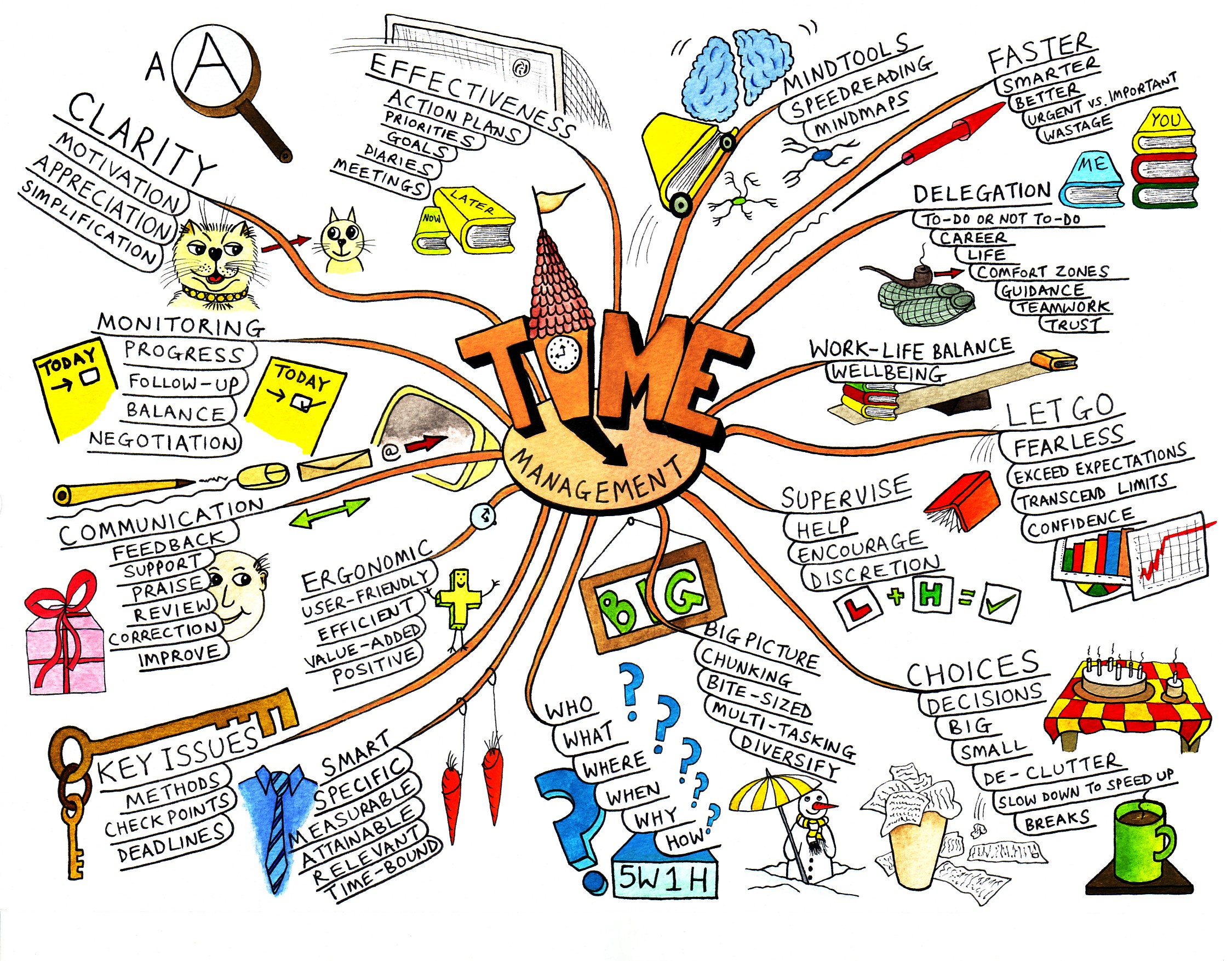
Mind Mapping is an important technique that improves the way you record information, and supports and enhances your creative problem solving. By using Mind Maps, you can quickly identify and understand the structure of a subject. You can see the way that pieces of information fit together, as well as recording the raw facts contained in normal notes. More than this, Mind Maps encourage creative problem solving, as they hold information in a format that your mind finds easy to remember and quick to review.
Popularized by Tony Buzan, Mind Maps abandon the list format of conventional note taking. They do this in favor of a two-dimensional structure. A good Mind Map shows the 'shape' of the subject, the relative importance of individual points, and the way in which facts relate to one another.
Mind Maps are more compact than conventional notes, often taking up one side of paper. This helps you to make associations easily. If you find out more information after you have drawn the main Mind Map, then you can easily integrate it with little disruption.
Mind Maps are also useful for:
- Summarizing information.
- Consolidating information from different research sources.
- Thinking through complex problems.
- Presenting information in a format that shows the overall structure of your subject.
Drawing Basic Mind Maps
The Mind Tools site was originally planned and researched using Mind Maps. They are too large to publish here, however part of one is shown below. This shows research into time management skills:Figure 1: An Example Mind Map

To make notes on a subject using a Mind Map, draw it in the following way:
- Write the title of the subject you're exploring in the center of the page, and draw a circle around it. This is shown by the circle marked 1 in Figure 1, above.
- As you come across major subdivisions or subheadings of the topic (or important facts that relate to the subject) draw lines out from this circle. Label these lines with these subdivisions or subheadings. These are shown by the lines marked 2 in Figure 1.
- As you "burrow" into the subject and uncover another level of information (further subheadings, or individual facts) belonging to the subheadings above, draw these as lines linked to the subheading lines. These are shown by the lines marked 3 in Figure 1.
- Finally, for individual facts or ideas, draw lines out from the appropriate heading line and label them. These are shown by the lines marked 4 in Figure 1.
As you come across new information, link it in to the Mind Map appropriately.
A complete Mind Map may have main topic lines radiating in all directions from the center. Sub-topics and facts will branch off these, like branches and twigs from the trunk of a tree. You do not need to worry about the structure produced, as this will evolve of its own accord.
Note that the idea of numbered 'levels' in Figure 1 is only used to help show how the Mind Map was created. All we are showing is that major headings radiate from the center, with lower level headings and facts branching off from the higher level headings.
While drawing Mind Maps by hand is appropriate in many cases, software tools like MindGenius improve the process by helping to you to produce high quality Concept Maps, which can easily be edited and redrafted.
While drawing Mind Maps by hand is appropriate in many cases, software tools like MindGenius improve the process by helping to you to produce high quality Concept Maps, which can easily be edited and redrafted.
Improving your Mind Maps
Your Mind Maps are your own property: once you understand how to make notes in the Mind Map format, you can develop your own conventions to take them further. The following suggestions may help to increase their effectiveness:
- Use single words or simple phrases for information: Most words in normal writing are padding, as they ensure that facts are conveyed in the correct context, and in a format that is pleasant to read. In your own Mind Maps, single strong words and meaningful phrases can convey the same meaning more potently. Excess words just clutter the Mind Map.
- Print words: Joined up or indistinct writing can be more difficult to read.
- Use color to separate different ideas: This will help you to separate ideas where necessary. It also helps you to visualize of the Mind Map for recall. Color also helps to show the organization of the subject.
- Use symbols and images: Where a symbol or picture means something to you, use it. Pictures can help you to remember information more effectively than words.
- Using cross-linkages: Information in one part of the Mind Map may relate to another part. Here you can draw in lines to show the cross-linkages. This helps you to see how one part of the subject affects another.

Key Points
Mind Mapping is an extremely effective method of taking notes. Mind Maps show not only facts, but also the overall structure of a subject and the relative importance of individual parts of it. They help you to associate ideas and make connections that you might not otherwise make. If you do any form of research or note taking, try experimenting with Mind Maps. You will find them surprisingly effective!

How to Write a Good Essay
II. Introduction of Essay
A. Write a few sentences that lead into the main point of your essay
B. End the paragraph with your thesis statement (3 main points you are going to support)
1. First point in thesis
2. Second point in thesis
3. Third point in thesis
III. Body of Essay
A. Topic One - First Point in Thesis
1. Support your point with either quotations or solid evidence
2. Have at least five sentences
B. Topic Two - Second Point in Thesis
1. Support your point with either quotations or solid evidence
2. Have at least five sentences
C. Topic Three - Third Point in Thesis
1. Support your point with either quotations or solid evidence
2. Have at least five sentences
IV. Conclusion
A. Write a few sentences summarizing your essay
B. Restate your thesis and how you proved your point
Once you fill in the blanks to this outline with your topic and information, the rest is easy! Make sure to check your spelling and punctuation, and then you're good to go!
10 TIPS IMPROVE YOURSELF TO SPEAK ENGLISH
Yes, you can. All you need to do is train yourself to speak English as comfortably and perfectly as you speak your mother tongue.
 How do you train yourself? By inculcating certain practices in your daily lifestyle. These will get you closer to sounding like a native English speaker and equip you with a global accent -- and you will speak not American or British English, but correct English.
This is the first step to learn any other accent, be it American or British or Australian.
Lisa Mojsin, head trainer, director and founder of the Accurate English Training Company in Los Angeles, offers these tips to help 'neutralise' your accent or rather do away with the local twang, as you speak.
1) Observe the mouth movements of those who speak English well and try to imitate them.
When you are watching television, observe the mouth movements of the speakers. Repeat what they are saying, while imitating the intonation and rhythm of their speech.
2) Until you learn the correct intonation and rhythm of English, slow your speech down.
If you speak too quickly, and with the wrong intonation and rhythm, native speakers will have a hard time understanding you.
Don't worry about your listener getting impatient with your slow speech -- it is more important that everything you say be understood.
3) Listen to the 'music' of English.
Do not use the 'music' of your native language when you speak English. Each language has its own way of 'singing'.
3) Listen to the 'music' of English.
Do not use the 'music' of your native language when you speak English. Each language has its own way of 'singing'.
4) Use the dictionary.
Try and familiarise yourself with the phonetic symbols of your dictionary. Look up the correct pronunciation of words that are hard for you to say.
5) Make a list of frequently used words that you find difficult to pronounce and ask someone who speaks the language well to pronounce them for you.
Record these words, listen to them and practice saying them. Listen and read at the same time.
6) Buy books on tape.
Record yourself reading some sections of the book. Compare the sound of your English with that of the person reading the book on the tape.
7) Pronounce the ending of each word.
Pay special attention to 'S' and 'ED' endings. This will help you strengthen the mouth muscles that you use when you speak English.
8) Read aloud in English for 15-20 minutes every day.
Research has shown it takes about three months of daily practice to develop strong mouth muscles for speaking a new language.
8) Read aloud in English for 15-20 minutes every day.
Research has shown it takes about three months of daily practice to develop strong mouth muscles for speaking a new language.
9) Record your own voice and listen for pronunciation mistakes.
Many people hate to hear the sound of their voice and avoid listening to themselves speak. However, this is a very important exercise because doing it will help you become conscious of the mistakes you are making.
10) Be patient.
You can change the way you speak but it won't happen overnight. People often expect instant results and give up too soon. You can change the way you sound if you are willing to put some effort into it.
25 December 2010
CONJUNCTION
What is a Conjunction?
You can use a conjunction to link words, phrases, and clauses, as in the following example:
- (I ate the pizza and the pasta.)
- (Call the movers when you are ready.)
Co-ordinating Conjunctions
You use a co-ordinating conjunction ("and," "but," "or," "nor," "for," "so," or "yet") to join individual words, phrases, and independent clauses. Note that you can also use the conjunctions "but" and "for" as prepositions.
In the following sentences, each of the highlighted words is a co-ordinating conjunction:
- (-Lilacs and violets are usually purple.)
In this example, the co-ordinating conjunction "and" links two nouns.
- (-This movie is particularly interesting to feminist film theorists,for the screenplay was written by Mae West.)
In this example, the co-ordinating conjunction "for" is used to link two independent clauses.
- (-Daniel's uncle claimed that he spent most of his youth dancing on rooftops and swallowing goldfish.)
Here the co-ordinating conjunction "and" links two participle phrases("dancing on rooftops" and "swallowing goldfish") which act as adverbsdescribing the verb "spends."
Subordinating Conjunctions
A subordinating conjunction introduces a dependent clause and indicates the nature of the relationship among the independent clause(s) and the dependent clause(s).
The most common subordinating conjunctions are "after," "although," "as," "because," "before," "how," "if," "once," "since," "than," "that," "though," "till," "until," "when," "where," "whether," and "while."
Each of the highlighted words in the following sentences is a subordinating conjunction:
- (-After she had learned to drive, Alice felt more independent.)
The subordinating conjunction "after" introduces the dependent clause "After she had learned to drive."
- (-If the paperwork arrives on time, your cheque will be mailed on Tuesday.)
Similarly, the subordinating conjunction "if" introduces the dependent clause "If the paperwork arrives on time."
- (-Gerald had to begin his thesis over again when his computer crashed.)
The subordinating conjunction "when" introduces the dependent clause "when his computer crashed."
- (-Midwifery advocates argue that home births are safer becausethe mother and baby are exposed to fewer people and fewer germs.)
In this sentence, the dependent clause "because the mother and baby are exposed to fewer people and fewer germs" is introduced by the subordinating conjunction "because."
Correlative Conjunctions
Correlative conjunctions always appear in pairs -- you use them to link equivalent sentence elements. The most common correlative conjunctions are "both...and," "either...or," "neither...nor,", "not only...but also," "so...as," and "whether...or." (Technically correlative conjunctions consist simply of a co-ordinating conjunction linked to anadjective or adverb.)
The highlighted words in the following sentences are correlative conjunctions:
- (-Both my grandfather and my father worked in the steel plant.)
In this sentence, the correlative conjunction "both...and" is used to link the two noun phrases that act as the compound subject of the sentence: "my grandfather" and "my father".
- (Bring either a Jello salad or a potato scallop.)
Here the correlative conjunction "either...or" links two noun phrases: "a Jello salad" and "a potato scallop."
- (Corinne is trying to decide whether to go to medical school orto go to law school.)
Similarly, the correlative conjunction "whether ... or" links the twoinfinitive phrases "to go to medical school" and "to go to law school."
- (The explosion destroyed not only the school but also the neighbouring pub.)
In this example the correlative conjunction "not only ... but also" links the two noun phrases ("the school" and "neighbouring pub") which act as direct objects.
Note: some words which appear as conjunctions can also appear as prepositions or as adverbs.
NOUNS
KINDS OF NOUNS
Proper Nouns and Common Nouns
Proper nouns are nouns that represent a unique entity (like a specific person or a specific place).
Common nouns which describe an entire group of entities (examples would be the nouns village or women).
Proper nouns as a general rule are capitalized in the English language. Common nouns as a general rule are not capitalized.
Sometimes the same word can function as both a common noun and a proper noun, where one such entity is special. For example the common noun god refers to all deities, while the proper noun God specifically refers to the monotheistic God.
Countable and Uncountable or Noncount Nouns
Countable nouns are common nouns that can become a plural. They can combine with exact numbers (even one, as a singular) or indefinite numbers (like "a" or "an").
Uncountable (or noncount) nouns are different from by the simple fact that they can't become plural or combine with number words. Examples from English include "indigestion" and "furniture".
Collective Nouns
Collective nouns name groups consisting of more than one individual or entity. The group is a single unit, but it has more than one member. Examples include "family", "committee", "corporation","faculty", "army", and "school".
Concrete Nouns and Abstract Nouns
Concrete nouns refer to their ability to register on your five senses. If you can see, hear, smell, taste, or feel the item, it's a concrete noun.
Abstract nouns on the other hand refer to abstract objects such as ideas or concepts, like the nouns "politeness" or "hatefulness".
Possessive Nouns
A possessive noun is a noun that names who or what has something. The possessive form is used with nouns referring to people, groups of people, countries, and animals.
It also refers to where someone works or plays or spends their time.
Add an apostrophe and s ('s) to form the possessive of most singular nouns (ex. Bob's jacket, the cat's tail, Steven King's books).
Add an apostrophe (') to form the possessive of plural nouns that end with s (ex. retailers' stores, soldiers' weapons, Americans' banks).
Add an apostrophe and s ('s) to form the possessive of plural nouns that do not end with s (ex. geese's nest, children's toys, women's dresses).
STUDY & LEARN THESE VERBS
Study and learn these verbs:
To Eat
| Present (Today) I eat you eat he eats she eats it eats we eat you eat they eat | Past Tense: (Yesterday) I ate you ate he ate she ate it ate we ate you ate they ate |
To Go
| Present (Today) I go you go he goes she goes it goes we go you go they go | Past Tense: (Yesterday) I went you went he went she went it went we went you went they went |
To Be
| Present (Today) I am you are he is she is it is we are you are they are | Past Tense: (Yesterday) I was you were he was she was it was we were you were they were |
To Have
| Present (Today) I have you have he has she has it has we have you have they have | Past Tense: (Yesterday) I had you had he had she had it had we had you had they had |
Subscribe to:
Posts (Atom)